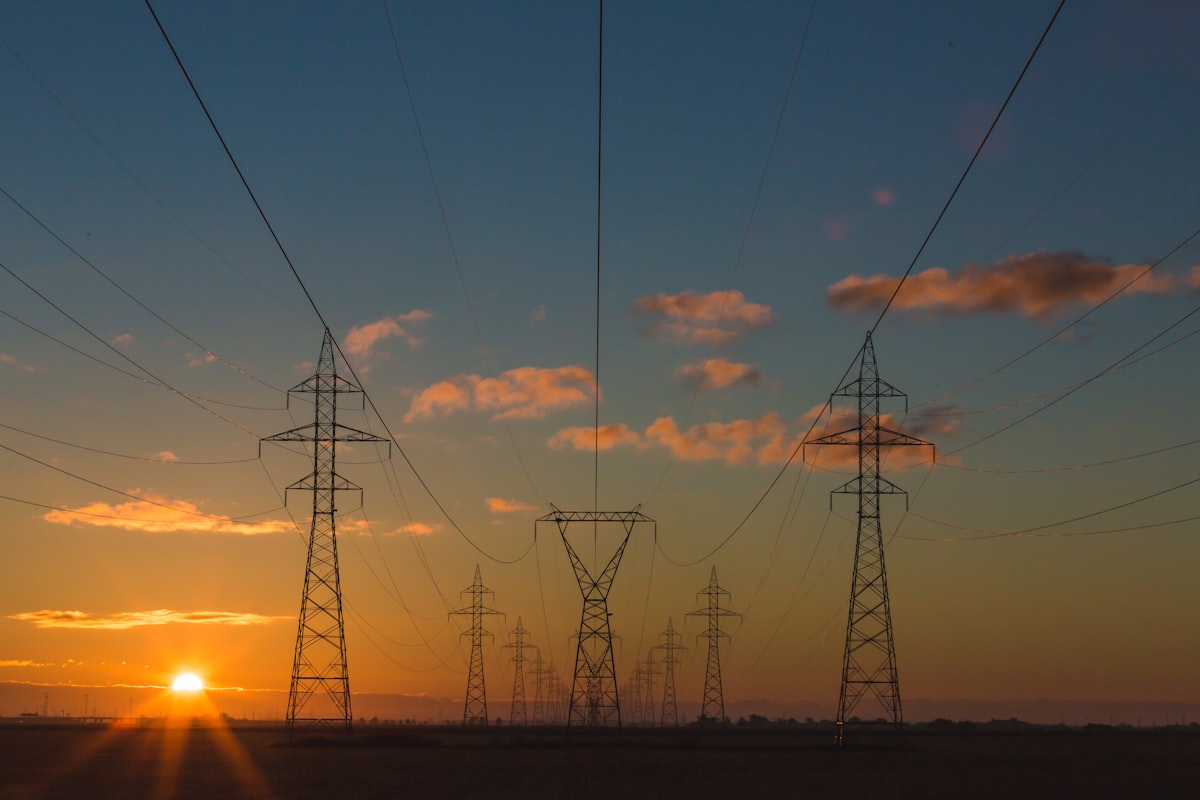
When a renewable energy project in Rajasthan sells power to a factory in Karnataka, the electricity travels across the inter-state transmission system (ISTS) — the high-voltage backbone operated under central regulation. Using that backbone normally attracts inter-state transmission charges, which can add ₹1.00–1.50 per unit to the landed cost of power. For inter-state renewable open access, the waiver of these charges has been one of the single most important economic levers of the past decade.
The CERC (Sharing of Inter-State Transmission Charges and Losses) Regulations, 2020, as amended by the 4th Amendment dated June 26, 2025, now sets out a definitive timeline for how long these waivers will last. For any C&I consumer evaluating inter-state renewable procurement — or any developer building capacity to serve them — this timeline is essential planning information.
What are ISTS charges — and why the waiver matters
India's renewable resource is concentrated. The best solar irradiation and wind speeds are found in a handful of states — Rajasthan, Gujarat, Tamil Nadu, Karnataka, Andhra Pradesh. But demand is spread across the whole country, including states with poor renewable resource. Inter-state transmission is what connects the two.
ISTS-connected renewable capacity (excluding large hydro) grew from just 3.95 GW in October 2019 to 39.6 GW by June 2025 — a nearly ten-fold increase in under six years, lifting ISTS's share of total RE capacity to around 20%. The transmission charge waiver was a major catalyst of that growth: by removing ₹1.00–1.50 per unit of transmission cost, it made inter-state renewable power competitive against local grid supply almost anywhere in India.
The 4th Amendment timeline
The 4th Amendment establishes a clear, date-based tapering of the ISTS waiver for solar, wind, and hybrid projects, keyed to the project's commissioning date:
| Commissioning date | ISTS waiver | Duration |
|---|---|---|
| On or before June 30, 2025 | 100% (full waiver) | 25 years |
| Successive years to June 30, 2028 | Progressively lower: 75% → 50% → 25% | 25 years |
| After June 30, 2028 | No waiver | — |
The message is unambiguous: the era of the full ISTS waiver for solar and wind has effectively closed for new projects. A project commissioned in, say, FY 2026–27 will receive only a partial waiver, and anything commissioned after June 30, 2028 will pay full inter-state transmission charges for its entire life.
How storage, hydrogen & ammonia are treated
The amendment extends differentiated treatment to emerging technologies, reflecting the policy priority of firming and decarbonisation:
- Pumped storage projects awarded for construction by June 30, 2028 receive a 25-year waiver.
- Battery Energy Storage Systems (BESS) are treated based on their connection and charging source — storage charged from waiver-eligible renewable generation can inherit favourable treatment.
- Green hydrogen and green ammonia projects, as consumers of ISTS capacity, benefit from waivers ranging from 100% down to 25% for projects commissioned up to December 31, 2033 — a notably longer runway than solar and wind, reflecting the government's green hydrogen push.
For hydrogen and ammonia, the waiver applies to drawal schedules from renewable or hydro generation, or from energy storage systems that meet at least 51% of their annual electricity requirement from renewables. Where multiple eligibility paths overlap, the most favourable source determines the waiver percentage — and CERC has provided detailed illustrations for these scenarios.
The force majeure safety net
Recognising that many projects face delays through no fault of their own — particularly where transmission infrastructure isn't ready — the amendment includes a protective provision. Projects originally scheduled for commissioning by June 2025 that are delayed due to force majeure or transmission system delays can still retain their full waiver if granted an extension.
The mechanics are important: an extension can be granted for up to two periods of six months each (one year total). Critically, if the project is then commissioned before the extended date, it is treated as if commissioned on June 30, 2025 — preserving the full 100% waiver. In effect, a project could be commissioned as late as June 30, 2026 and still secure the full 25-year waiver, provided it qualifies for both extensions.
What this means for C&I open access buyers
The ISTS waiver tapering reshapes the calculus for any C&I consumer relying on inter-state renewable open access. Four practical implications:
- Lock in waiver-eligible supply now. If you are contracting inter-state renewable power, prioritise projects already commissioned (or commissioning imminently) that carry the full 25-year waiver. These will retain a structural cost advantage over later projects for decades.
- Model the post-2028 cost cliff. Any PPA tied to a project commissioning after June 2028 must price in full ISTS charges. When comparing offers, normalise for the waiver — a cheaper headline tariff on a non-waiver project may be more expensive landed.
- Consider intra-state alternatives. As the inter-state waiver tapers, intra-state renewable open access (where the generation and consumption are within the same state) becomes relatively more attractive, since it avoids ISTS charges entirely. State-level wheeling and CSS still apply, but the transmission component is lower.
- Captive remains insulated. Captive and group captive structures are driven primarily by the CSS and additional surcharge exemption, not the ISTS waiver. For consumers prioritising long-term cost certainty, captive structures are less exposed to the 2028 transmission cliff.
The 4th Amendment is, on balance, a rationalisation: the waiver did its job of catalysing the first wave of large-scale renewable build-out, and the government is now tapering support as the sector matures. But for C&I buyers, the window to lock in full-waiver inter-state supply is closing. The projects commissioned before mid-2025 — carrying their 25-year full waiver — are a finite and increasingly valuable pool. Securing offtake from them, or pivoting to intra-state and captive structures, is the strategic response.
Want a Detailed Report on This Topic?
Receive an in-depth report tailored to your business — covering financial impact, compliance roadmap, and the procurement strategy that fits your load profile. Free, confidential, delivered within 48 hours.
Get Detailed Report →